Exclusive
Coach SA Rahim took India to glory but was forgotten & unrewarded by the government

Almost 70 years ago, in November 1956, India, which was led by Samar Banerjee and trained by the country’s most successful coach Syed Abdul Rahim of Hyderabad, finished in the fourth pace in the football competitions of the Melbourne Olympic Games. The most outstanding game was India’s 4-2 victory over host Australia. Thereby India became the first Asian team in history to enter the semi-finals of the Olympic Games.
The highlight of the fierce battle was a hattrick scored by Neville D’Souza, one of coach Rahim’s handpicked players. No Indian player has scored a hattrick at the Olympic Game since that day. Indeed, India has never qualified to play at the Olympic Games after 1960. Mainly because India lacked the services of a coach like Rahim after he retired.
In the following decades, India employed the services of highly paid foreign coaches from Europe but none of them could deliver the results that the humble schoolteacher from Hyderabad did many years ago.
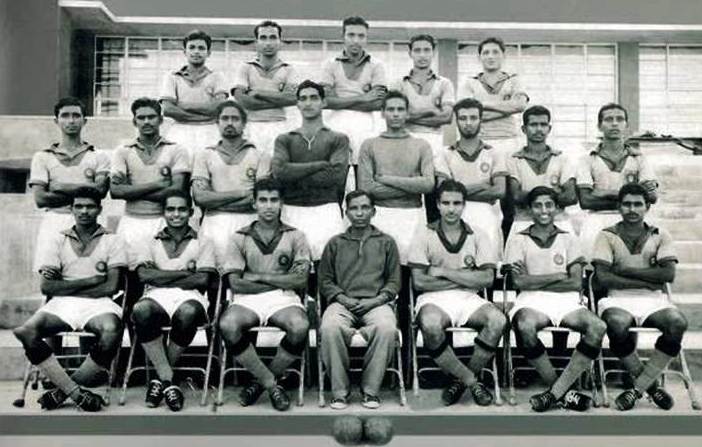

Now whenever we watch the FIFA World Cup matches or the UEFA competitions, we marvel at the skill and stamina of the teams. It is difficult to imagine that once India was the best team in Asia and could also match some of the European teams. A large part of the credit for attaining that high level of success is due to the dedicated effort of just one man, Syed Abdul Rahim.
Rahim was like a football magician
No discussion on Indian football can be complete without acknowledging the contributions of Rahim sahab. It was under his guidance that India came fourth in the Melbourne Olympics in 1956 and twice took the gold medal in the Asian Games beating teams like Japan and Korea. Now Japan is one of the world’s top teams, but we are happy if we can beat Bangladesh. Indian football needs the magic of another Rahim now.
Sadly, Rahim passed away when he was only 53 due to cancer. His last assignment was the Asian Games in Indonesia in 1962. He was entrusted with the task of coaching the Indian team. But he was already suffering from the dreaded cancer, and he knew that his days were numbered.
A thrilling final match
The final match was against the well drilled and fast-moving South Koreans. They were a formidable side, and it would be extremely difficult for India to defeat Korea. So, Rahim knew that he would have to fire up his team emotionally. A few minutes before the match began, he called the players together and told them: “Ladkon, Aaj meri ek akhri kwaish puri kar do. Mujhe ek gold medal dilwa do.”
The players knew that their coach would not be with them again. He was going away forever. They made a commitment that the last wish of their leader must be fulfilled at all costs. The Indonesian crowd was totally against India. They hurled insults and abuse at the Indian players as they entered the field.
But India was determined to succeed. With Rahim’s plea ringing in their ears, they went into the field with fire in their hearts and played like lions against the stronger Korean opponents. Playing excellent football, P K Banerjee and Jarnail Singh scored two goals for India while Cha Tae Sung scored the only goal for Korea.
Players were in tears
Then, after receiving their medals, the players collected all the medals together and came to Rahim and put the medals in his hands. But they had tears in their eyes even as they did so. The coach was so overcome that he was unable to speak.

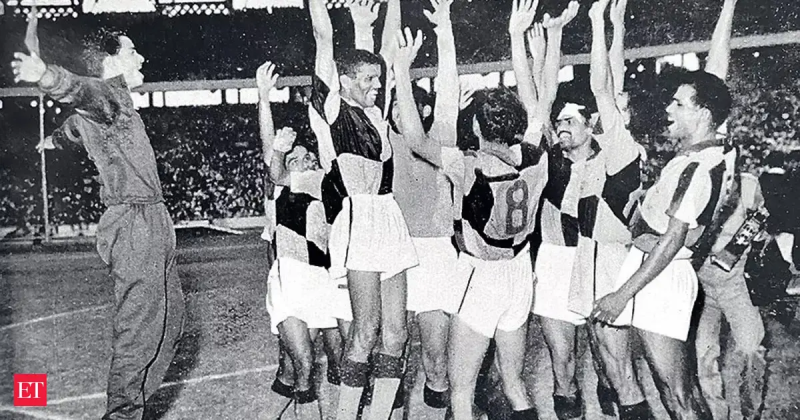
Playing excellent football, P K Banerjee and Jarnail Singh scored two goals for India while Cha Tae Sung scored the only goal for Korea. Pic: Economic Times
In the dressing room, the team sat sombre and silent. There were no celebrations. When Rahim walked in, he found that the mood was like that of a team which had lost, not won the match. He tried to cheer them up. He said: “Aaj hum jeet gaye hain. Aaj jashan manao. Aisa mauka bar-bar nahi agyeya.”
Then he hugged each player individually and told them to stay in high spirits always. “All of you are my children. May you have many victories in the future,” he said. With these final words of encouragement, he walked out of the room for the last time and never returned.
These are stories (all factual stories stated in interviews and records) that should be cherished by all those who are sports lovers in Hyderabad. The above recollections, about what Rahim said and did, were told to this correspondent by footballers Yusuf Khan and S A Salam who were members of Rahim’s triumphant teams.
Rahim was a teacher by profession. He worked in the Kachiguda Middle School, Urdu Sharif School, Darul-ul-Uloom High School and Chaderghat High School. He then took a diploma in physical education and took charge of sports activities for children of all ages.
Brain behind the success of Hyderabad City Police
He made Hyderabad City Police into one of the best teams in India. Strong teams like East Bengal, Mohun Bagan and Mohammedan Sporting could not cope with the Hyderabad outfit. Between 1950 and 1963 Hyderabad City Police won the Rovers Cup in Mumbai for a record nine times.
Bygone era: Hyderabad’s football had shone like a beacon and HCP was the torchbearer
He picked up young boys and turned them into football heroes. Rahim was a far-sighted man, but his efforts went unrewarded by the government. He received no recognition or reward. He deserved at least a Padma Sri but was overlooked again and again. It was a sad way to treat the coach who made every Indian proud.
Slide began after Rahim departed
After Rahim’s departure, the slide began. It was not immediately noticeable. The decline was gradual but steady. Currently India’s FIFA world ranking is 141. Even small countries like Vietnam, Panama, Costa Rica and Burkina Faso of Africa are ahead of us.
Japan and Korea, whom we had beaten at the Asian Games in 1962, are now ranked 19 and 22 respectively. Both have played in the FIFA World Cup final phase. Japan played 8 times and Korea 11 times. Whereas India has never reached that level.