Exclusive
The astonishing tale of four women who represented India at the 1952 Olympics

Indian women, when it comes to fighting against heavy odds and overcoming obstacles, have proved time and again that they are second to none. At the 1952 Olympic Games in Helsinki, four women represented independent India for the first time. They were Nilima Ghosh, Mary D’Souza Sequeira, Arati Saha and Dolly Nazir. The first two were track athletes and the second two were swimmers. Although they did not win any medals, what was admirable was their enthusiasm, passion to excel and eagerness to see that Indian women did not go unrepresented in world sport’s most important arena.

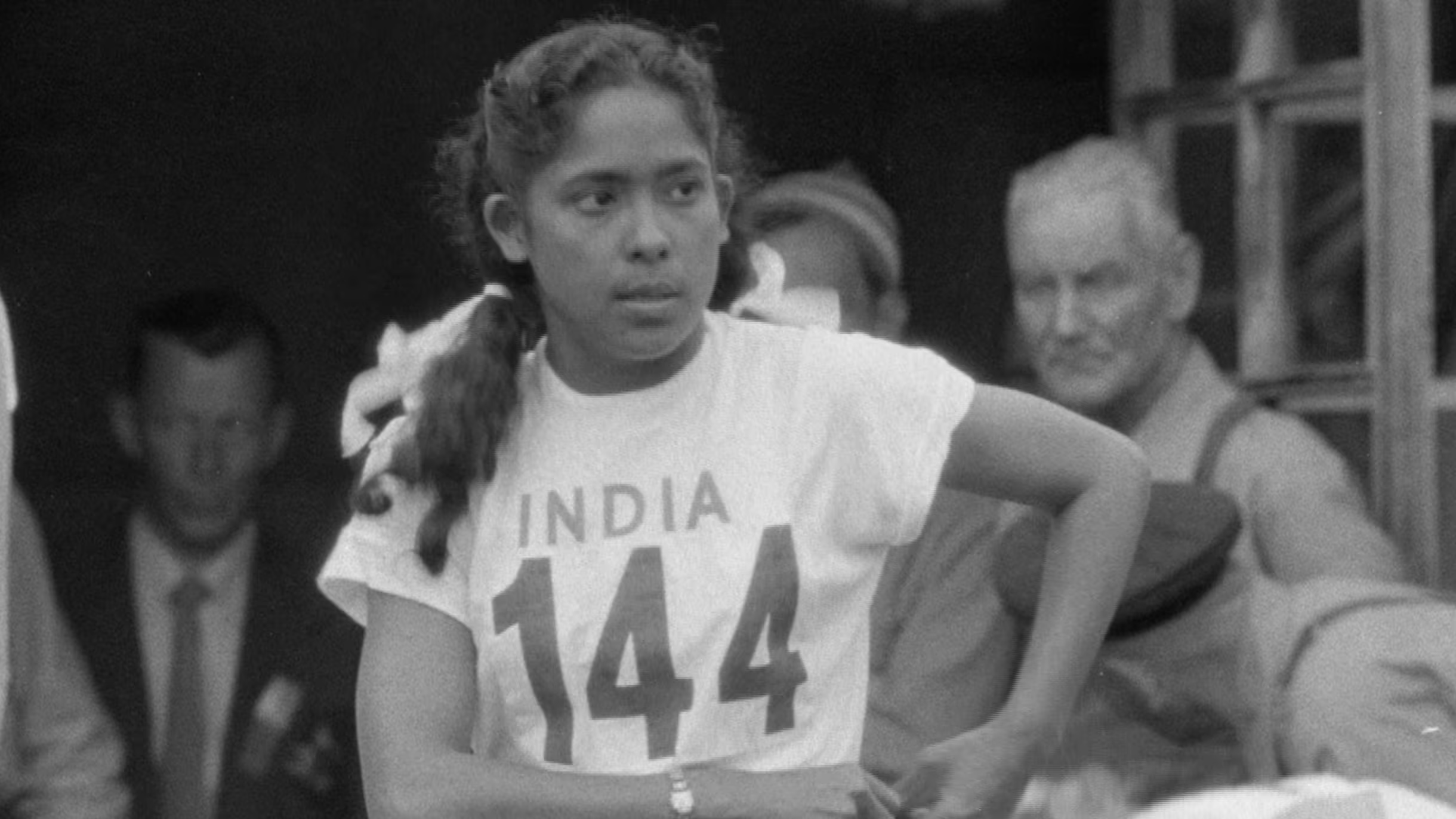
In 1952, at Helsinki, the athletes had to fend for themselves. If the food was strange, they had to figure out what to do, if they had a muscle strain, they had to heal themselves, they had to find out on their own when their races were to be held. And they had to make their own travel arrangements. No manager to arrange a team bus. And after all this, they had to fight it out with the world’s legendary athletes
India had become an independent country only five years before the 1952 Olympics and the Indian government had many targets to achieve. Providing roads, extending railways, building hospitals, schools and colleges for the large and underprivileged population was the top priority. Sport was perhaps not on the list at all. So, the athletes were left to their own devices.
Indian women who broke the glass ceiling in Olympic sports: Malleswari leads the pack
No funds but no lack of enthusiasm
On their own they had to run from pillar to post to acquire funds. We can imagine what that means. Long hours of waiting in office rooms of some well-heeled persons, rejections, broken promises and disappointments. They went through it all by themselves.

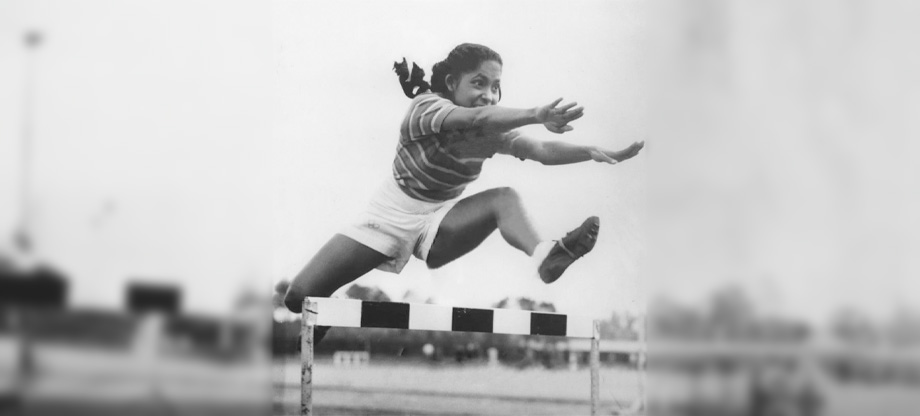
The first woman to represent India in the Olympic stadium was 17-year-old Nilima Ghosh. Her event began before that of Mary so Nilima took the honour of being the first Indian woman to compete on the track at the Olympics. Nilima took part in the 100 metres sprint and the 80 metre hurdles
When Mary D’Souza Sequeira qualified to take part in the Olympics, she had no funds. So, her friends organised a ball dance. Members of the Goan community to which she belonged, were asked to donate generously to ensure that their girl did not miss the opportunity because of lack of finances. That was how they collected some funds which enabled Mary to represent India at the 1952 Olympics. The other participants also managed to acquire funds by different means.
https://www.instagram.com/p/ChPyXv-LHDt/?utm_source=ig_web_copy_link&igsh=NTc4MTIwNjQ2YQ==
No coaches or manager to provide help
They had no coaches and no support staff to accompany them. Nowadays, if an athlete wins a medal he or she is able to do so because they have a coach, physio, doctor, dietician and masseur who helps them to reach their peak.

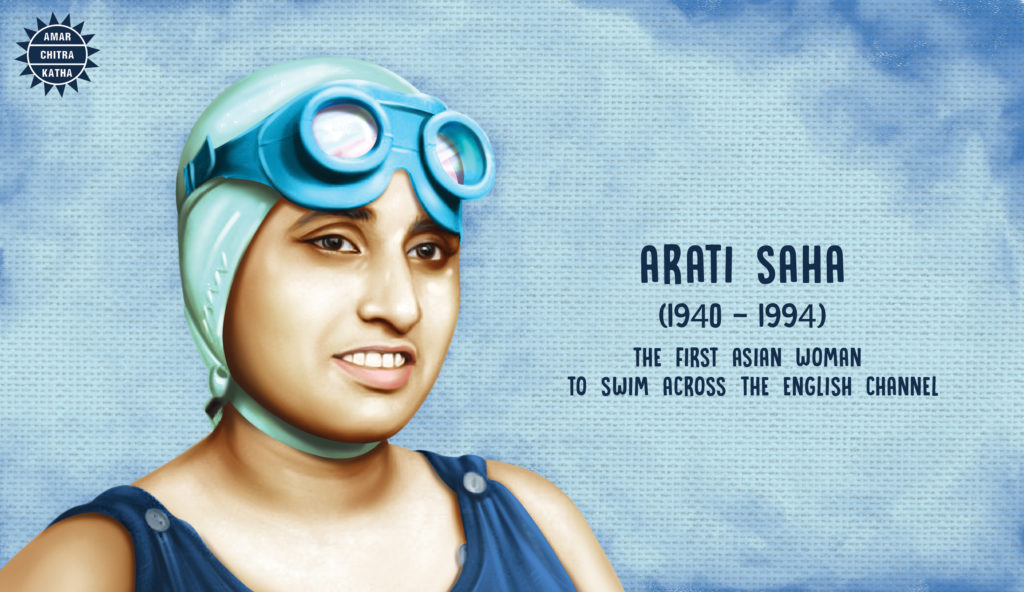
After the Olympics, in 1959, Arati gained fame as the first Asian woman to swim across the English Channel
In 1952, at Helsinki, the athletes had to fend for themselves. If the food was strange, they had to figure out what to do, if they had a muscle strain, they had to heal themselves, they had to find out on their own when their races were to be held. And they had to make their own travel arrangements. No manager to arrange a team bus. And after all this, they had to fight it out with the world’s legendary athletes.
The women were enthusiastic and passionate
So, given this background, we can only admire their enthusiasm and passion. They helped to ensure that the Indian Tricolour was carried into the stadium in front of thousands of spectators.
Nilima was the first woman to represent India
The first woman to represent India in the Olympic stadium was 17-year-old Nilima Ghosh. Her event began before that of Mary so Nilima took the honour of being the first Indian woman to compete on the track at the Olympics. Nilima took part in the 100 metres sprint and the 80 metre hurdles.
Mary D’Souza Sequeira was an extraordinary woman. She represented India in athletics as well as hockey (separate hockey events, not in the Olympics). Mary won medals in the Asian Games and was India’s first woman double international athlete (meaning she represented India internationally in two different sports).

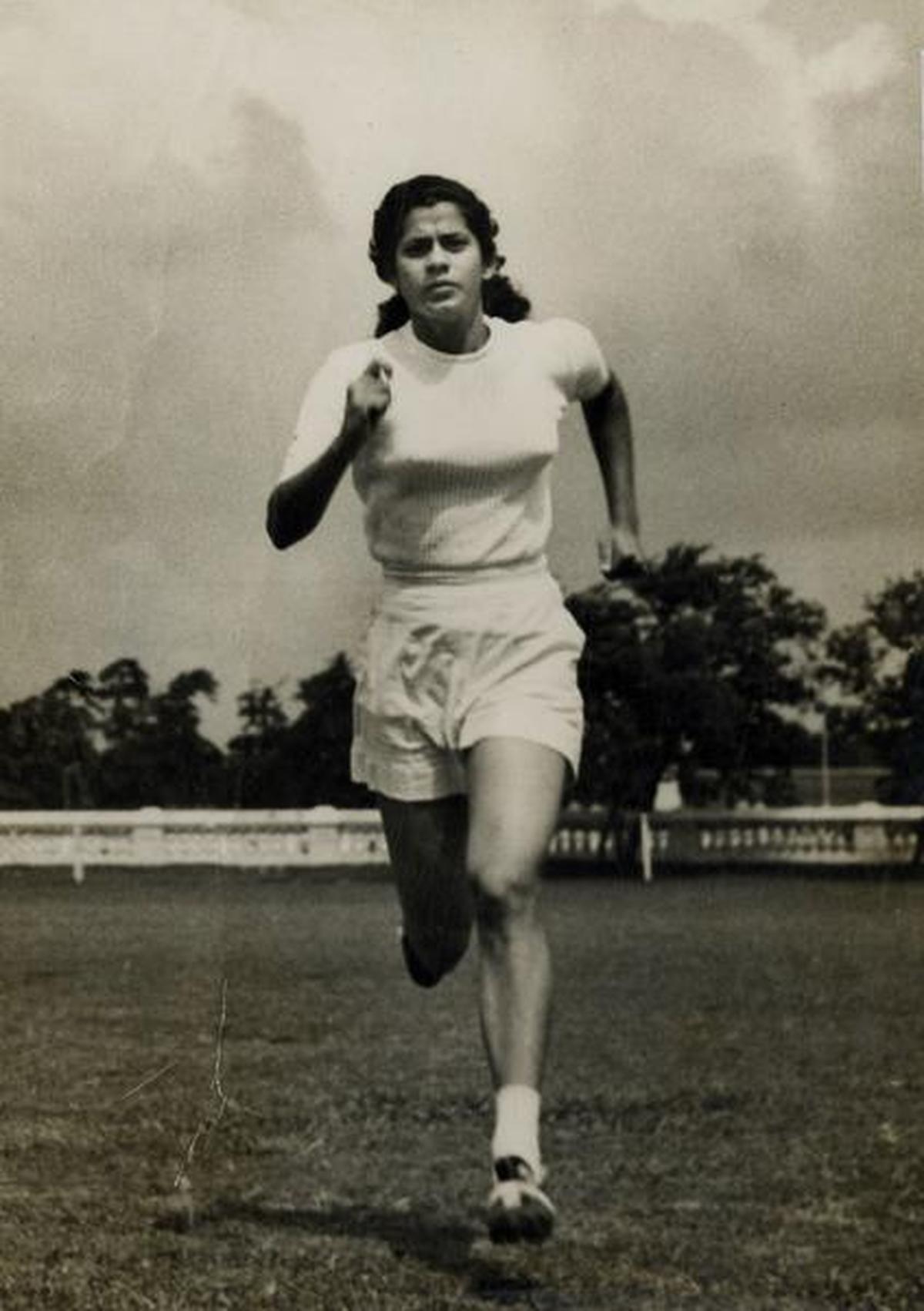
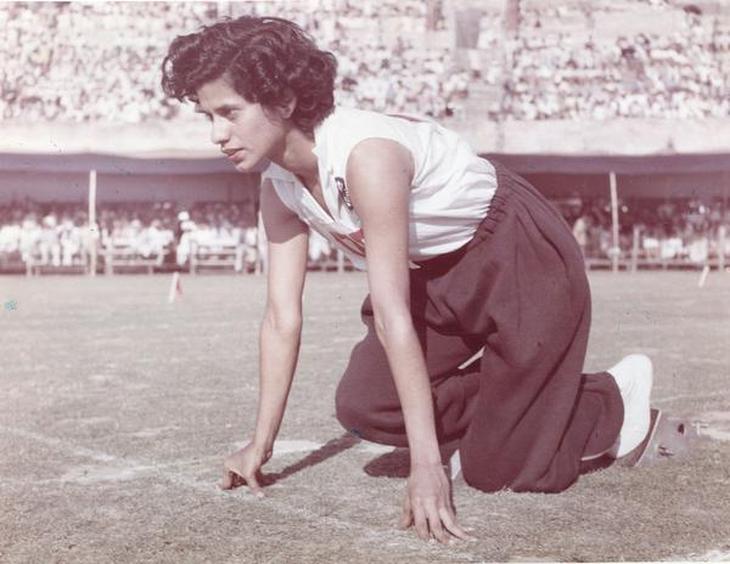
Mary D’Souza Sequeira was the Asian record holder with 12.3 seconds over 100m and 12.5 seconds over 200m. She was also one of India’s top scorers in women’s hockey. Pic: The Hindu
She set Indian national records in 100m, 200m and 80m hurdles. She was the Asian record holder with 12.3 seconds over 100m and 12.5 seconds over 200m. She was also one of India’s top scorers in women’s hockey. Having won two medals in the first Asian Games in 1951, Mary was a little more experienced athlete than Nilima. Decades later, she was belatedly honored with the Dhyan Chand award by the Indian Govt in 2013. Now, aged 90, she lives in Mumbai.
The other two women were swimmers Arati Saha and Dolly Nazir. After the Olympics, in 1959, Arati gained fame as the first Asian woman to swim across the English Channel. She grew up under a single parent namely her father. Her mother passed away when she was about two years old. Her father was in the armed forces so she and her siblings were brought up by other family members.
Arati was trained by the famous Sachin Nag
She was trained by Sachin Nag, the man who won India’s first-ever gold medal in the Asian Games in 1951. Between 1945 and 1951, Arati won 22 state-level competitions in West Bengal. Her main events were 100m freestyle and 200m breaststroke. At the national level she came second only to Dolly Nazir of Bombay.

Dolly Nazir too was a very talented swimmer. She won the Long Distance Open Sea Championships in Bombay in 1948 at the age of 13 and repeated the win the next year. In November 1950, she bettered the National record for 100m backstroke by more than three seconds while winning the All India Swimming Championships. At the Helsinki Olympics she competed in two events and gave her best effort.
Dolly married famous horse trainer Byramji
Dolly Nazir later married Rashid Byramji, one of the legendary names of horse racing in India. In a career spanning more than six decades, Byramji held the records for registering 3,170 wins in different racing meets across India. This included 230 classics. He was the only trainer to have trained 10 Indian Derby winners and 12 Indian Invitation Cup winners. Dolly passed away in 2012 at the age of 77 while Byramji passed away in 2022 at the age of 87.

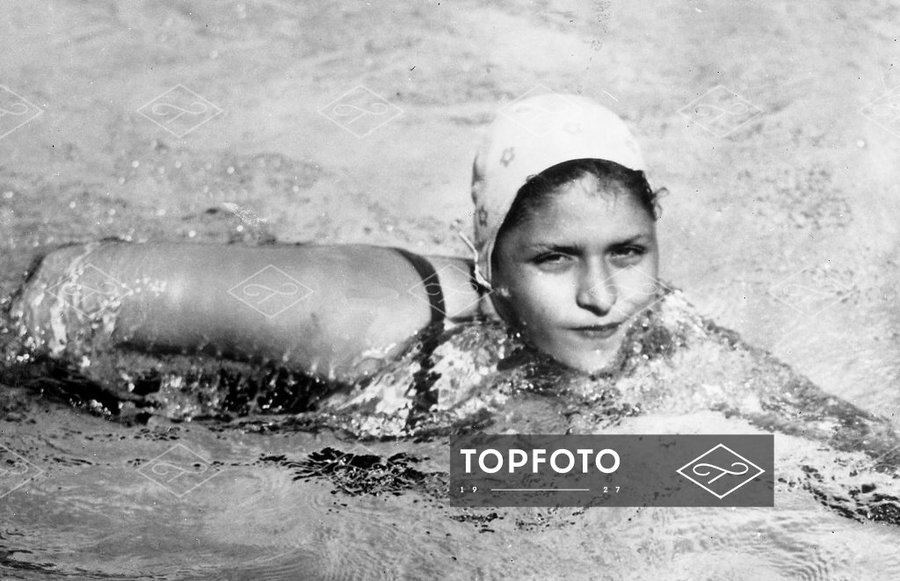
In November 1950, she bettered the National record for 100m backstroke by more than three seconds while winning the All-India Swimming Championships
Amazing story of Mary D’Souza Sequeira
As for Mary D’Souza Sequeira, her story was probably the most remarkable of all. She was a multiple medal winner in athletics as well as hockey. She won a bronze medal in the 200m and a silver medal in the 4×100m relay at the Asian Games in 1951 and then followed it up with a gold medal as a member of the 4x100m relay team in the 1954 Asian Games. Her teammates in that event were Stephie D’Souza, Violet Peters and Christine Brown.
Mary was India’s first double international
She was India’s first double international sportsperson. She played field hockey for India in 1953 when the team went on a tour of England and took part in the first International Women’s Field Hockey tournament (that was what it was called). She played for India again in 1956 in Australia, in the second international tournament. She also donned the national colours for hockey Test matches against Japan in 1964 and also against Ceylon. She then served as a sports officer in the Indian Railways and in that capacity she coached and recruited sportspeople for the railway teams.
https://x.com/ronojoy_sen/status/1309077168652201985/photo/1
Honoured with the Dhyan Chand award
Her services to sports were given due recognition when she was honoured with the Dhyan Chand award in 2013 from the Government of India. In an interview to the Times of India in 2022, she revealed that she was the 7th of 12 children of a large family. Her father was an engine driver in the railways who used to tell her that if she felt the need for exercise, she should sweep the floor of their house instead of running about on sports fields.

It was always difficult. There was no money in sports and we got no prize money or from doing advertisements. But I never regretted it. I always loved to compete and I’m always grateful I got a chance. Without my athletic career I would have never got to see the world. I was able to represent my country as a sports ambassador across the world. And that will always be special to me, said Mary
She was born in 1931 and grew up in house number 151 on Hill Road in Bandra, Mumbai (then Bombay). She studied in the St Joseph’s convent school in Bandra and began playing hockey on the municipal ground behind her house. But her speed in running was also noticed by everyone. Her cousin signed her up for a track meet and that was how her running talent was discovered.
When the Indian women took part in the 1952 Olympics, their colourful sarees caught everyone’s attention. But they had no equipment. She told TOI that the legendary Harrison Dillard of the USA who won Olympic gold medals in sprinting as well as hurdling, was surprised that she had no starting blocks. He then gave her his own starting blocks.
No prize money but no regrets, said Mary
In an interview in 2018, she told ESPN: “It was always difficult. There was no money in sports and we got no prize money or from doing advertisements. But I never regretted it. I always loved to compete and I’m always grateful I got a chance. Without my athletic career I would have never got to see the world. I was able to represent my country as a sports ambassador across the world. And that will always be special to me.”