Exclusive
Good, bad and the ugly: Hattrick man Chetan, remembered more for Miandad’s six, turns 60

In William Shakespeare’s play The Tragedy of Julius Caesar, Mark Antony, while addressing the citizens of Rome, says: “Friends, Romans, countrymen, lend me your ears. I come to bury Caesar, not to praise him. The evil that men do lives after them, the good is oft interred with their bones.” A similar thing seems to have happened in the cricketing career of Chetan Sharma.
The former India all-rounder celebrates his 60th birthday on Saturday (January 3) after having ended his playing career in 1994. He played his last Test in 1989 and his last ODI in 1994. With 61 Test wickets, 67 ODI wickets, and 3,714 first-class runs, his contributions across formats reflect a career built on consistency and commitment.
In the course of his career, he took many crucial wickets and scored vital runs. He even took a hat-trick (the first one in World Cup history) in the Reliance World Cup in 1987 against New Zealand. It was the same match in which legendary opener Sunil Gavaskar, who has 34 Test hundreds against his name, scored his one and only ODI century, 103 runs in 88 balls.
But whenever his name crops up in a discussion, people only remember that he gave away a last ball six to Javed Miandad in the final of the Austral-Asia Cup in 1986 in Sharjah. It is a stigma that Sharma’s heroic performances over the years have not been able to wipe out from public memory. So, Mark Antony’s words hold true in the case of Sharma’s cricket career.
The match in question took place in Sharjah almost 40 years ago, on April 18, 1986, to be precise. So, to refresh memories about the proceedings, here is a brief recap. Pakistan skipper Imran Khan won the toss and decided to field first. India posted a good total of 245 for 7 in 50 overs. In reply, Pakistan lost wickets at regular intervals, but Javed Miandad held one end firm and scored runs with singles and doubles at a steady pace.
Eventually it came down to the last ball. Pakistan needed four runs from the last delivery with Chetan Sharma bowling to Miandad. It looked like India had the edge. But to the shock of all viewers, Chetan, probably unnerved by the tension, bowled a full toss to Miandad. The batter gleefully lofted the ball over midwicket and that six ended India’s hopes. No cricket fan, who watched that last ball, has been able to forget what happened that day or forgive poor Chetan Sharma for his blunder even though four decades have passed.

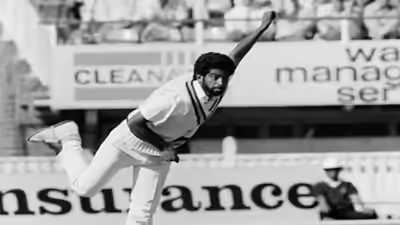
Chetan Sharma played in the Moin-ud Dowla cricket tournament in Hyderabad and made a mark that year as an outstanding all-rounder
Chetan’s career is a study in contrasts
Sharma’s cricket career was a study in contrasts. It was marked by moments of success but also painful setbacks. Before gaining fame as an international cricketer, Chetan Sharma played in the Moin-ud Dowla cricket tournament in Hyderabad and made a mark that year as an outstanding all-rounder. In one match he took seven wickets and proved his value as a good lower order batter, who could rattle off a quick 30 or 40 runs if required. The media began comparing him with another Haryanvi and the legendary all-rounder Kapil Dev for a while. He remained Kapil’s able partner for almost five years.
Chetan’s career had some glorious moments. He made his debut in Tests against Pakistan at Lahore in 1984. In his very first over, he bowled Pakistan opener Mohsin Khan and became the third Indian to take a wicket in his first over in Test cricket.
First hat-trick in World Cup history
Three years later, he hogged the headlines when he became the first Indian to take a hat-trick in a World Cup, against New Zealand in 1987. He bowled Ken Rutherford, Ian Smith and Ewen Chatfield to clinch a marvelous hat-trick. It was a landmark achievement that etched his name into Indian cricket history and briefly symbolised the arrival of a new pace-bowling hope at a time when India were still searching for fast-bowling depth.
His hat-trick was also the first by an Indian bowler in the ODI format. He was also a part of the Indian squad which won the 1985 World Championship of Cricket in Australia.

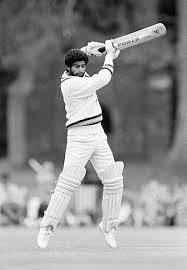
With the bat, he played the most significant innings of his career against England in the Nehru Cup in 1989. Sent in at No.3 with India facing a target of 256, he scored 101 not out in 96 balls with eight 4s and one 6 and hit the match winning run
With the bat, he played the most significant innings of his career against England in the Nehru Cup in 1989. Sent in at No.3 with India facing a target of 256, he scored 101 not out in 96 balls with eight 4s and one 6 and hit the match winning run. But, unfortunately, soon after this his bowling skills began to wane considerably. He was excluded from the tour of Pakistan later that year.
Chetan got very few opportunities thereafter. In one of his last international appearances, against New Zealand in a three nations tournament in 1994, he ended up with figures of 1–0–23–0 as he was hit for five fours off consecutive balls by New Zealand great Stephen Fleming. He moved from Haryana to Bengal in 1993 and stayed there till the end of his career in 1996.
Chetan, who is the nephew of 1983 World Cup hero Yashpal Sharma, opened a fast-bowling cricket academy in Panchkula, Haryana, in 2004 but which closed down in 2009. He also worked as a commentator.
After leaving cricket, he dabbled in politics and served as Chief Selector for the BCCI in two phases. During the second stint, Sharma was entrapped in a sting operation wherein he alleged that many players take injections to expedite their return to competitive cricket despite being 80 to 85 per cent fit.
Sharma also claimed that there was an ego tussle between former India captain Virat Kohli and former BCCI President Sourav Ganguly. The footage went viral and created a huge controversy. The sting fiasco led to his resignation from the post. But Chetan is a man who cannot be kept down for long.
Here’s wishing the gritty Chetan Sharma a happy 60th birthday.